

The compliance lifecycle
Every business registered with a US state moves through the same three stages. Formation. A business becomes a legal entity when a state accepts its formation filing. Until then it cannot open accounts, sign contracts, or hold assets in its own name. Most businesses also need an EIN, the IRS-assigned tax identification number, before they can hire, bank, or file taxes. Ongoing compliance. Registration is not permanent. States require periodic filings and fees to keep an entity in good standing, and every state-registered business must name a registered agent to receive legal and government documents. When a required filing is missed, the state can suspend or administratively dissolve the registration. A suspended entity is a live problem for anyone who lends to it, banks it, or relies on its standing. Remediation. A business that has lost good standing can usually recover it, but recovery is rarely a single form. States generally require the missed filings, the outstanding fees, and a penalty before they will restore the registration.What you can do through the API
Comply does three things today.
Palm’s compliance infrastructure maps the filing requirements, deadlines, fee structures, and submission processes for all 50 US states and DC. For the entity types available today, see Form an LLC and Form a corporation.
How Comply connects to Onboard, Verify, and Monitor
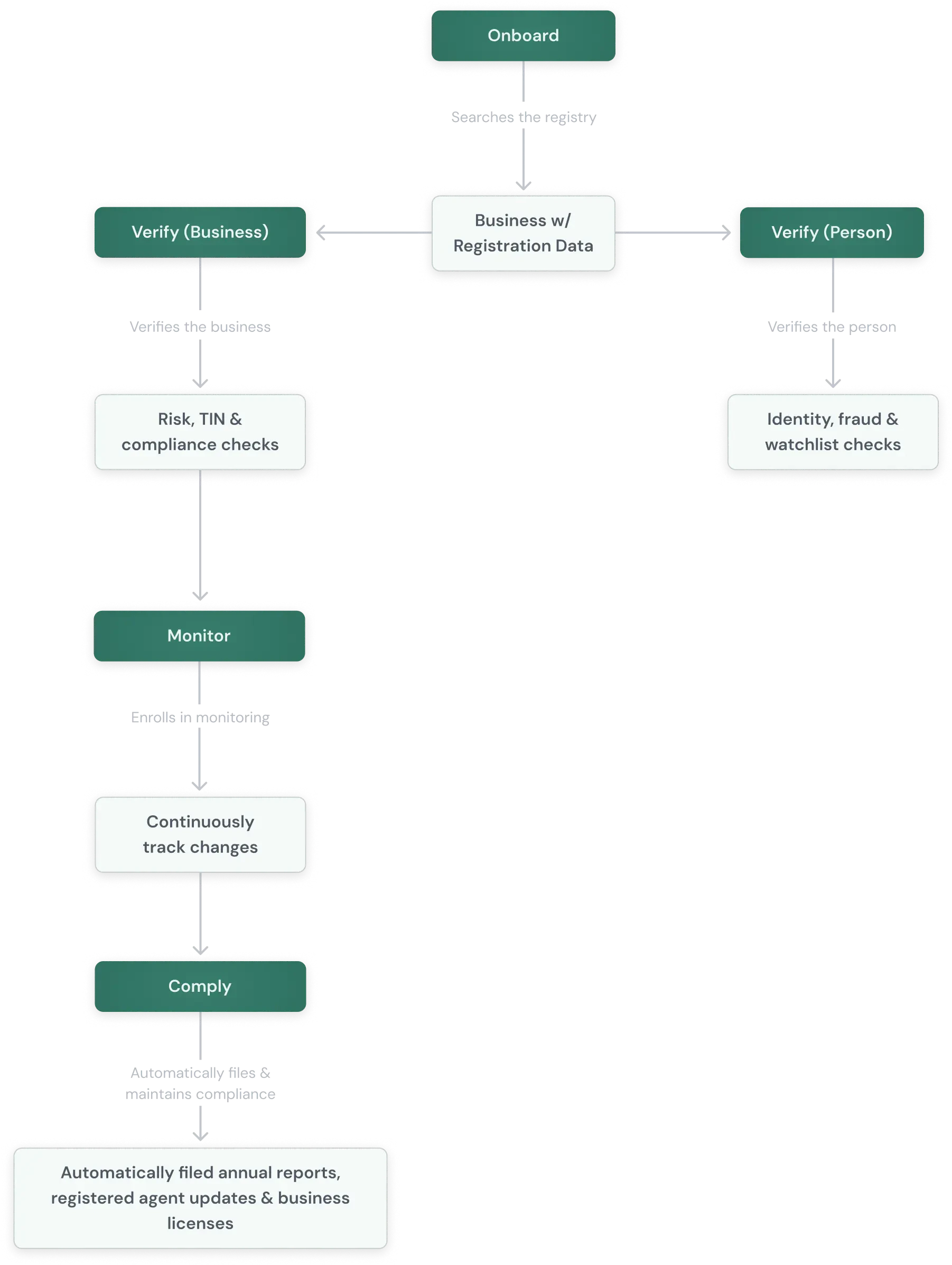
Each product feeds the next. A business formed through Comply is immediately available to Verify and Monitor without re-entering data, and a standing change surfaced by Monitor tells you a business needs action. Because every accepted filing updates the record with state-confirmed data, the record stays current through compliance work the business already has to complete.
How filings work
Forming a business and applying for an EIN each create a filing: a tracked record that carries its own status, fees, cases, and documents. The filing object is generic. The lifecycle, the case mechanism, and document delivery work the same way no matter what Palm files.Registered agent service is not a filing. Palm tracks it on its own resource at
GET /v1/business/{business_id}/registered-agent, with its own lifecycle. See Registered agent.The lifecycle
When nothing interrupts it, a filing takes this path:queued, ready_to_file, processing, and filed all mean Palm is working. A filing.* webhook fires at each transition, so you can drive your UI from events rather than polling.
Waiting on you. A case is open on the filing. This is the only state that blocks on you, and Palm tracks it separately from status. See below.
Finished. On completed, the result holds the registration number for a formation or the EIN for an application. The other terminal statuses mean the filing stopped, and status_reason says why.
For the full status list and the shape of every field, see Retrieve a filing.
When Palm needs something from you
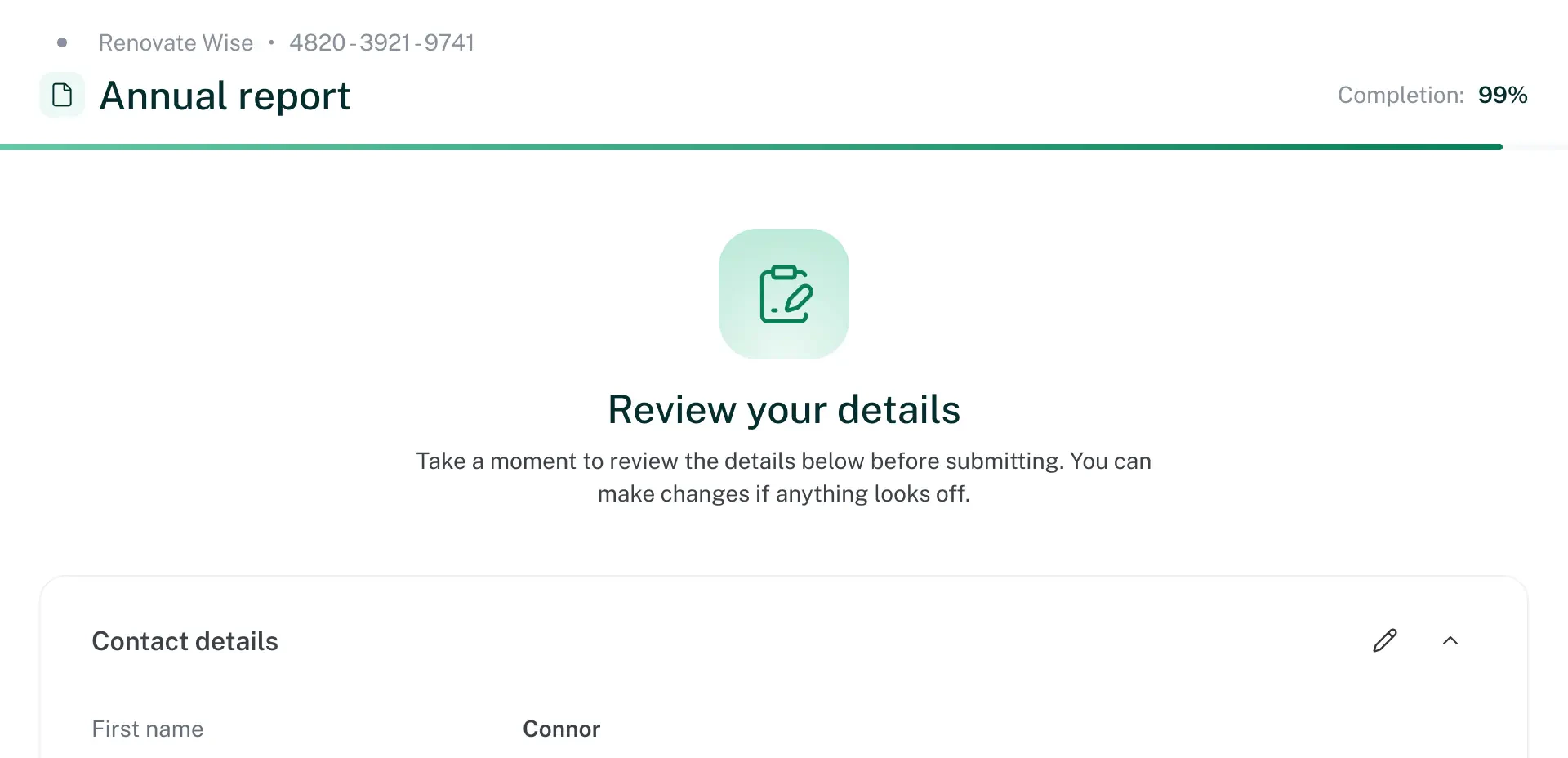
Most filings finish on the original request alone. When Palm needs something more, a correction or a detail not collected at submission, it opens a case on the filing and notifies you with acase.opened webhook.
The request arrives as a description of what Palm needs, whether that is a value or a document, so you can render the prompt directly from the payload.
See Cases for the lifecycle and how to respond.
Documents
A completed filing carries the documents it produced: articles of organization or incorporation, IRS confirmation letters, state certificates, and receipts. Retrieve each through the Documents API for as long as you hold the record.Fees and expedited processing
Filing fees vary by state, entity type, and filing method, and several states price a filing on inputs specific to that state: authorized shares, par value, authorized capital, member count. Palm exposes this through a dedicated fee endpoint rather than a static table, so you can show a member a cost before they commit.Every fee returned before submission is an estimate. Where a state prices a filing on inputs you supply, Palm applies that state’s rules to calculate the estimate. Palm sets the final amount when the filing completes and sends it with the
filing.completed webhook. The receipt on the completed filing is the source of truth.Validate before you submit
Every filing type has a matching validate endpoint that checks a payload against the state’s compliance rules without creating a filing or a business record. It returns every compliance error in one pass, which makes it well suited to inline validation in your collection flow, so a member fixes the problem while they are still in the form rather than after the filing is queued.Before you begin
- A Palm API key. Get access
- For formation, the business data the target state requires.
- For EIN, an existing business record with the required fields populated.
Capability enablement. The capabilities that act on a business — formation, EIN, and registered agent — are enabled per account rather than on by default, because they file real records with government authorities. Contact us and tell us about your use case.