

Acceptance and Accuracy
The market for business identity has two sides, and most of it is focused on the wrong one.The network
Palm powers a network of 125M businesses. Each identity in the network is connected to the authoritative government sources that created it. When your platform verifies a business through Palm, that verification doesn’t disappear after the API call. The verified data enters a centralized store of every data point Palm has confirmed against authoritative sources. That data then becomes reusable across the network. A business verified by one partner doesn’t need to start from zero with the next. This is what makes Palm a network, not just an API. Every verification strengthens the graph. Every monitored business adds a signal. The more platforms that use Palm, the more accurate and current the network becomes.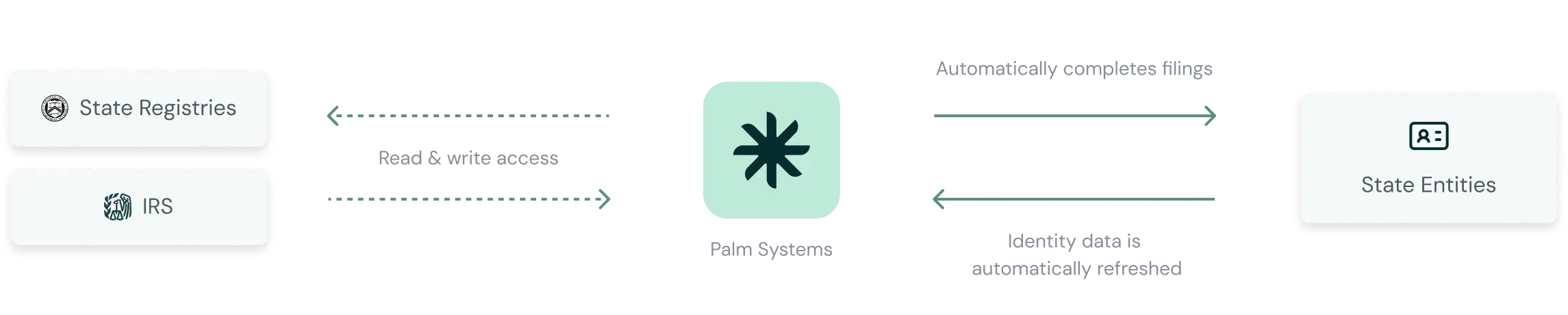
Concepts
Palm’s data model has two core entities. Understanding them is essential before working with any endpoint.Everything starts with a Search
Before you verify a business, enroll it in monitoring, or trigger a compliance action, you find it. Search is not a prerequisite — it is the entry point to every workflow Palm supports. Think of Palm’s registry as a live index of 125 million US businesses, sourced directly from all 50 Secretary of State offices and the IRS. When a business registers with a state, it enters the registry. When it files an annual report, changes its Registered Agent, or updates its officers, that change propagates. You are always working with authoritative data, not an aggregated snapshot. This matters because the first question any onboarding flow has to answer is: does this business actually exist? Registry search answers that question before you spend a single verification credit.Business
A Business is a registered business entity — an LLC, corporation, or any other legal structure recognized by a government authority. It has:- Vault data: Legal name, EIN, entity type, registration jurisdiction, and any other business details you collect
- Metadata: External IDs and custom fields you define to link the business back to your system
- Display name: A human-readable label for the entity
User
A User is a person — associated or not to a business. Users represent the humans behind business entities: owners, beneficial owners, officers, Registered Agents, or authorized signers. It has:- Identity data: Name, date of birth, email, and other PII stored in the vault
- Metadata: External IDs and custom fields you define to link the user back to your system
Palm ID
Every real business in the United States has a Palm ID. It’s a permanent identifier for the entity itself. When you submit a business for verification, Palm resolves the input to the correct Palm ID. Verification is the act of matching your data to an existing identity. This is what makes identity reusable across the Palm network. The verified data linked to a Palm ID persists regardless of which partner triggered the verification. A business verified by one partner doesn’t need to start from zero with the next.The vault
The vault is where partner-collected data lives before verification. When a business onboards through your platform, the data they submit — name, EIN, address, officers — is stored in your vault. This data is unverified by default. Each partner maintains their own vault. The vault supports stepwise onboarding, so you can collect data incrementally rather than requiring everything upfront. Sensitive fields are stored with field-level encryption.